
Atascosa County VINELink Uses IVSS
“VINELink” is now legacy and search-intent language in Texas. The Attorney General reports that county notification moved from VINE to Texas IVSS-Counties on September 1, 2025, and existing registrations migrated. Atascosa County Sheriff's Office links the IVSS-Counties portal for county offender search, registration, and custody or case notifications. The separate state IVSS portal covers TDCJ prison, parole, and mandatory-supervision events.
County events can include booking, release, death, escape, transfer to TDCJ, and some court changes when a participating agency supplies them. Coverage must still be checked inside the live portal. The ACSO link does not prove that every municipal, federal, or out-of-state event appears. State IVSS may send parole review, Board decision, release, discharge, or warrant events when applicable.
| Custody layer | Official route | Use |
|---|---|---|
| Atascosa county custody | IVSS-Counties | Participating county custody and case events |
| TDCJ prison or parole | TDCJ IVSS | State custody, review, release, supervision, discharge |
| Federal BOP | BOP inmate locator | Federal custody or released result |
| ICE | ICE detainee locator | Covered detention and recent-release window |
Check One Atascosa County Release
Select the portal that matches the custody source. A county jail event belongs in IVSS-Counties. A TDCJ prison or parole event belongs in state IVSS. Searching both may be proper after a county transfer to TDCJ, but the records must not be spliced into one status.
- Choose offender search in the proper official portal.
- Enter the person's name and a stronger identifier when offered.
- Compare agency, case or offender number, and identifying facts across possible matches.
- Open only the matched record and note its custody status, agency, event wording, and update time.
- If the record says released or transferred, preserve the wording and confirm with ACSO or TDCJ.
The county IVSS entry screen is the route ACSO endorses.
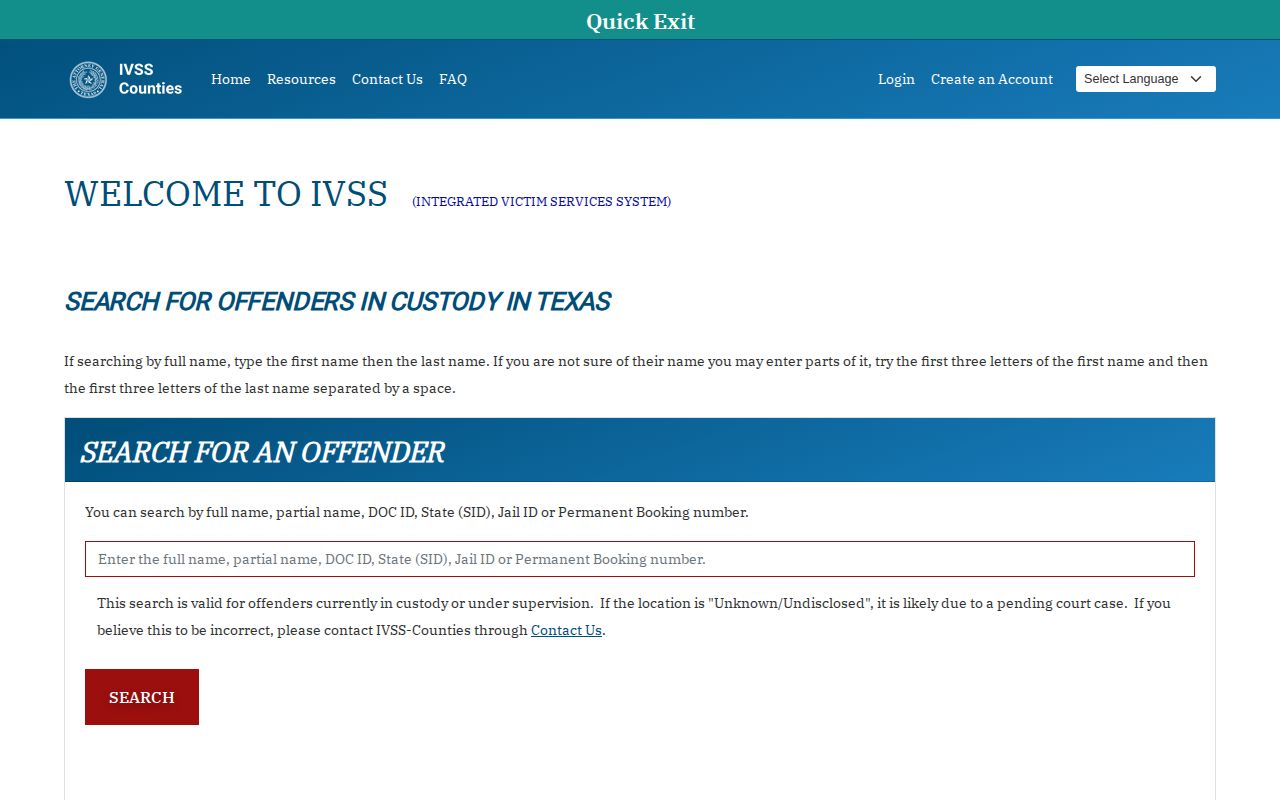
This local endorsement makes IVSS preferable to an unsourced commercial inmate search.
Read Atascosa County Release Events
A result or notice confirms that the named reporting agency transmitted an event. It does not prove the charge was dismissed, rule out a transfer, or establish that no other authority holds the person. “Released,” “out of custody,” “transferred,” “parole approved,” and “discharged” have different meanings.
| Field | How to use it |
|---|---|
| Name and identifier | Confirm the notice belongs to the intended person |
| Reporting agency | Identify which custody layer sent the event |
| Status or event | Quote it exactly; do not broaden its meaning |
| Time or update | Record when the provider posted the information |
| Notification history | Track saved notices without treating them as court disposition |
If IVSS reports release while an Atascosa court docket remains open, both facts can be correct. The first describes custody. The second describes prosecution. Confirm a county event through ACSO Booking at 830-769-3434 ext. 2231 or Jail Records at ext. 2239.
Register Atascosa County Release Notifications
Registration follows the matched record. Current county options can include call, text, and email, plus preferred hours or blackout dates when offered. Registration data is confidential under the program rules. County-system assistance is available at 866-268-8959. TDCJ prison and parole IVSS assistance is 800-848-4284, and state options can also include letters.
- Open the correct matched county or state offender record.
- Select registration or notifications, then create an account or sign in.
- Provide verified contact details and choose the methods currently offered.
- Set contact preferences when the portal presents them and complete its confirmation prompts.
- Save the registration, confirm it on the dashboard, and keep contact information current.
The state IVSS registration entry shows the TDCJ layer.
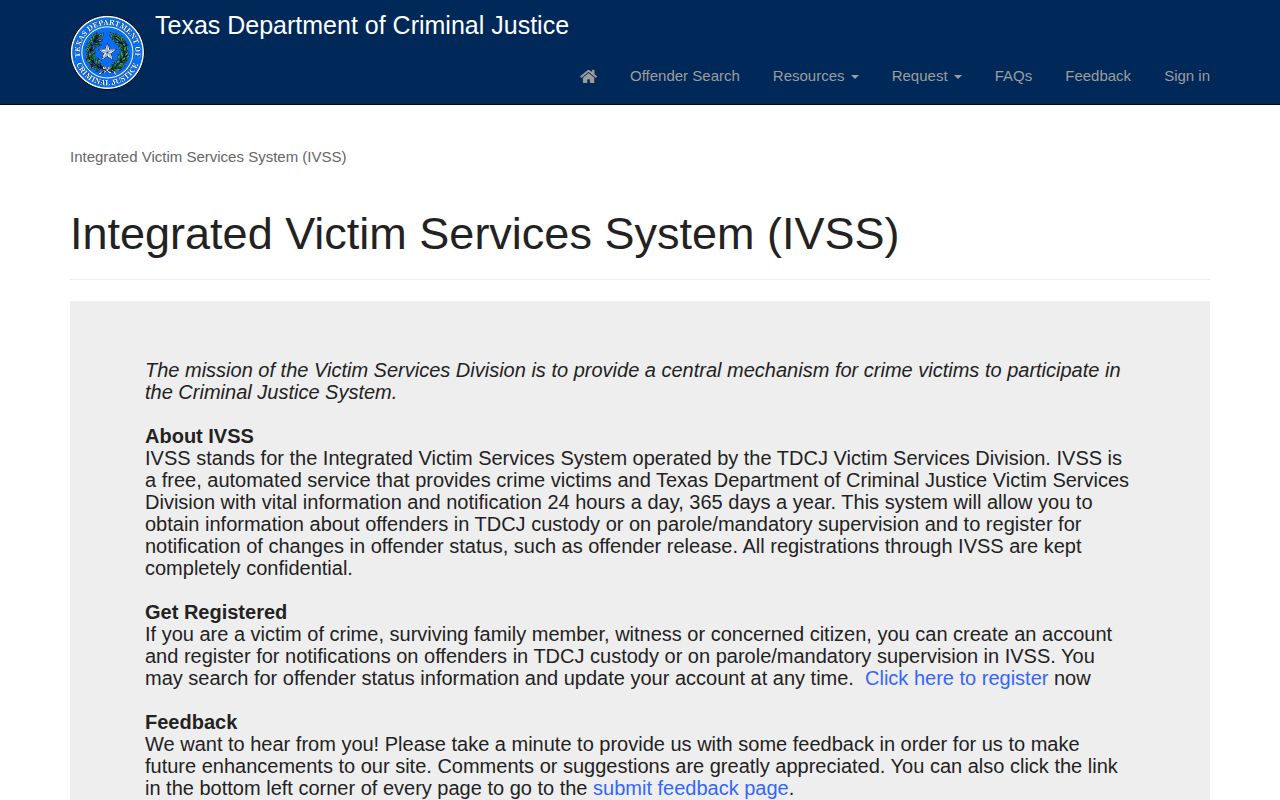
Use this state portal for prison and parole events, not as a substitute for an ACSO county transaction.
Confirm Atascosa County IVSS Release
Automated data can lag or be corrected. Capture the exact event, timestamp, agency, and identifier, then call the source when a safety or legal decision depends on it. Ask ACSO for the release or transfer transaction. For a state prisoner, use TDCJ release history, Classification and Records, or Parole Division. The TDCJ current-inmate search excludes discharged people, so a blank result is not a release certificate.
IVSS is not the federal locator. Use the BOP inmate locator for federal prison custody and the ICE detainee locator for the immigration layer. A federal “released” result does not rule out state, county, or another sovereign's custody. The full Atascosa County release verification path joins the custody record with the proper court file.
Legacy VINE PIN Instructions
Before the 2025 transition, the official Texas VINE brochure told telephone registrants to create a four-digit PIN. During an automated alert, the user entered that PIN followed by the pound sign to acknowledge the notice and stop repeat calls. Calls that were not acknowledged could recur for up to 48 hours.
Those steps explain what a migrated user may remember. They must not be presented as the current IVSS-Counties screen. New users should follow the live portal prompts, and migrated users may need a password update because the provider changed. The Attorney General transition notice is the current source for the change.
Why Atascosa County Links IVSS
The Atascosa County Sheriff's Office page directly points residents to IVSS-Counties and describes offender search, registration, and notifications. That local source answers which service should replace an old “VINELink Atascosa” bookmark. It does not guarantee that every agency or event participates, so coverage still must be confirmed in the portal.
The key split remains county IVSS versus state IVSS. A notice that ACSO transferred someone to TDCJ marks the end of county custody, not community release. Follow that person into the state system with the TDCJ identifier. Likewise, a state parole event should not be attributed to the county jail.
Identity checks matter at every stage. Common names, aliases, separate booking episodes, and transposed dates can create a false match. Prefer a booking number, SID, TDCJ number, or case number when the portal offers it. Save the date searched and the source URL. A newer timestamp is not automatically more accurate when two systems describe different custody layers.
Notification history is useful for a timeline, but it is not a certified release sheet. Request the ACSO transaction for a county event or TDCJ release history for a state event. Then consult the correct Atascosa court clerk if the question also concerns bond, sentence, dismissal, or a later setting. Custody and case status often change on different dates.
Notification preferences need upkeep. A changed phone number, blocked text sender, full email box, or expired account access can prevent a message from reaching the registrant even when the agency sent the event. Check the dashboard after registration, verify each selected channel, and update contact details. Do not rely on one automated message as the only plan for a time-sensitive release.
Some event labels mark movement within custody. A transfer to TDCJ, another county, federal authorities, or a treatment facility ends ACSO custody but does not place the person in the community. Follow the receiving agency and retain the county transfer record. If state intake has not yet appeared online, processing lag is a better explanation than a claim of freedom.
The Texas DPS Sex Offender Registry is also separate from IVSS. It covers only people with statutory registration duties and is not a general released-person database. A registry result cannot establish the Atascosa jail release date. Likewise, no registry result says nothing about whether an unrelated person was released, transferred, or discharged.
For a county event, a focused records request should name the person, booking number if known, and the event date. Ask ACSO for the release or transfer transaction and the receiving agency when applicable. For TDCJ, include the SID or TDCJ number and explain that the current-inmate search may no longer return the person. These records supply the durable source behind a short-lived notification.
Keep alerts in context. Release on bond does not close the Atascosa court case. Parole release does not end the prison sentence. Discharge is different from active supervision, and transfer is different from community release. Quoting the provider's exact phrase prevents a notice from being turned into a broader claim that the underlying record does not support.