
Atascosa Juvenile Record Boundary
The Atascosa County Juvenile Detention Center is listed in the Facility Map for one narrow reason: it prevents adult searches from being sent to the wrong system. Juvenile detention is not an adult county jail, a TDCJ prison, or a public list of released inmates. Its cases and records are governed by juvenile confidentiality rules. The correct response to a failed adult search is not to assume release. It is to determine whether the person is a child and whether the requester has lawful authority to contact the juvenile system.
No public-facing page should publish a youth's name, photograph, allegation, detention status, release date, placement, or supervision detail. Even a fact found in a stray adult index should not be used to rebuild a juvenile record. The Texas Public Information Act has exceptions, and juvenile law supplies a distinct layer of protection. The facility or court decides what can be shared with an authorized party.
Adult Searches Exclude Juvenile Releases
The Atascosa County Jail release workflow concerns the adult jail on Campbell Avenue. Booking extension 2231, Jail Records extension 2239, the adult release transaction, and the sheriff's daily processing times do not apply to a child at the Zanderson Avenue facility. An adult ACSO no-result cannot bridge that gap.
| Adult system | Why it is not the juvenile route |
|---|---|
| ACSO adult jail records | Tracks adult county-jail custody episodes, not confidential juvenile placement. |
| TDCJ inmate search | Lists only people currently incarcerated in a TDCJ facility and is not a youth locator. |
| IVSS county or state portal | Coverage depends on participating agencies and cannot be assumed to expose a child's event. |
| BOP or ICE locator | Federal tools have their own scope and do not replace the county juvenile system. |
| Adult court portals | Adult criminal indexes are not a substitute for a confidential juvenile case file. |
Do not search by relatives, aliases, or social posts to work around the boundary. That can produce a false match and reveal sensitive information about the wrong person. A guardian or lawyer should use the identity and case information approved by the juvenile office.
Atascosa Juvenile Center Contact
The official county page identifies the juvenile facility at 1511 Zanderson Avenue in Jourdanton. Its phone number is 830-769-3900. Contact staff for the current lobby schedule and instructions before going to the site. The page does not authorize public release searches or disclose a child's status.
1511 Zanderson Avenue
Jourdanton, TX 78026
Phone: 830-769-3900
24-hour facility; call for current lobby access
The official juvenile detention page is the source for this contact and facility description. The successful manifest capture below shows that county source.
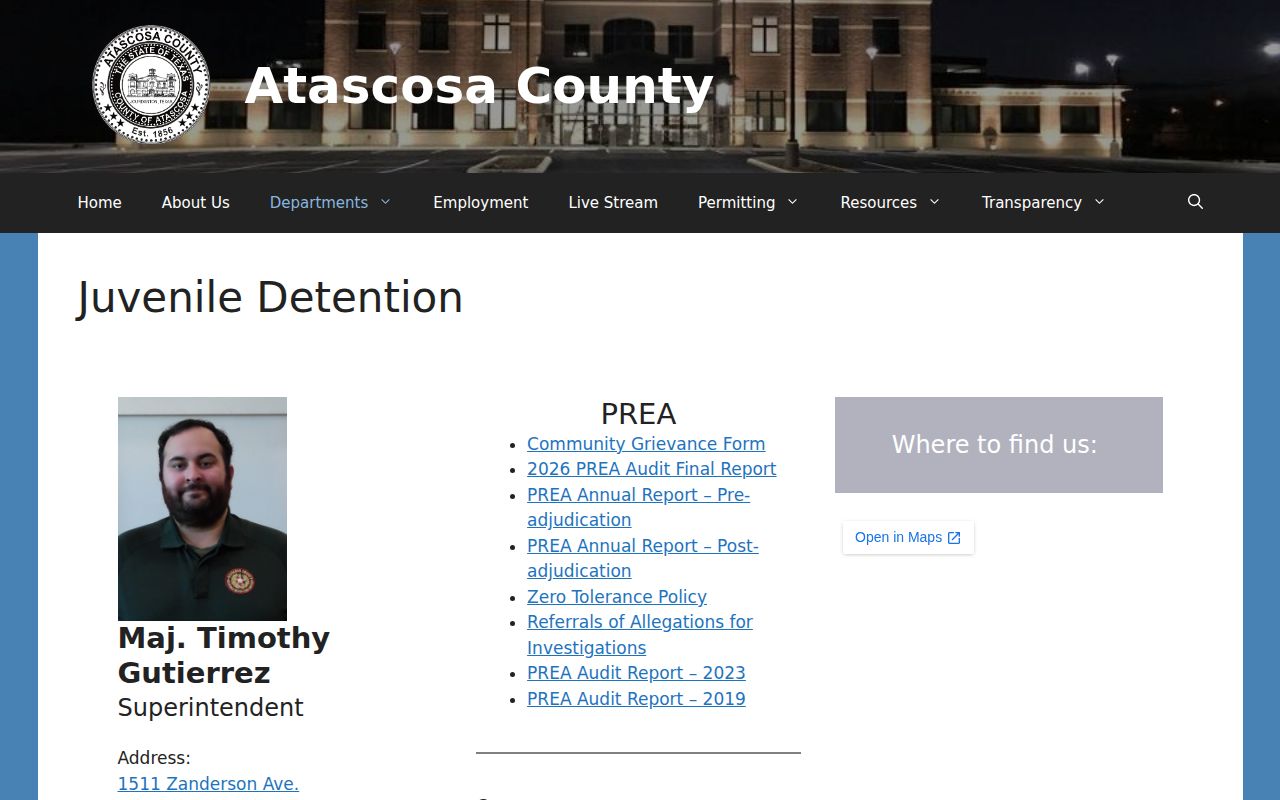
The image confirms the official contact path, not the detention or release of any child. Staff remain the authority for access rules and current operations.
Atascosa Juvenile Record Requests
A broad public request for a youth's booking sheet, photograph, or release sheet is not the adult records method described for ACSO. Juvenile material can be confidential under Texas law, and the custodian may require proof of status or a court process. An authorized party should describe the record needed, the case or event, and the legal relationship, then let the juvenile office identify what can be released.
Several records can exist without all being held by one office. The detention center may maintain secure custody and operational records. A juvenile court maintains its case file and orders. Counsel keeps client communications. A supervision or placement agency may have separate records. Ask which custodian created the needed document instead of sending one broad request to adult Open Records.
- Detention
- Secure temporary custody in the juvenile system; it is not an adult criminal sentence.
- Release
- An authorized end to that detention episode, which may include conditions or another placement.
- Placement
- A setting ordered or arranged through the juvenile process; it should not be inferred from a missing search result.
- Authorized party
- A person whose role and access rights the responsible office has verified.
Never ask an agency to disclose medical, victim, school, treatment, or unrelated family details. If an office denies access, request its written process or the legal basis applicable to the requester. Legal counsel can address disputes about a specific case.
Read Juvenile Release Carefully
Physical release from a detention building does not reveal the result of the juvenile case. The youth may return to a guardian, enter a court-approved placement, remain subject to supervision, or move under another lawful order. Those possibilities are not interchangeable. Only the authorized record or responsible professional can identify the event.
A court date, disposition, detention end, and supervision end may occur on different days. Public adult language such as bond, parole, TDCJ discharge, or BOP release should not be pasted onto a juvenile matter. Use the terms in the actual order. If a family must coordinate pickup or services, follow direct instructions from staff or counsel rather than an online schedule intended for the adult jail.
Confidentiality also continues after a youth leaves the building. A former detention episode does not become a public adult released-inmate record merely because time has passed. Do not repost screenshots, social claims, or inferred identities. Protecting that boundary is a core part of accurate Atascosa County record handling.
Correct Misdirected Atascosa Searches
When a search starts in the wrong place, first confirm age and system without making the inquiry public. If the person is an adult held at the county jail, use ACSO Booking and Jail Records. If a sentenced adult entered TDCJ, use the state route. Federal custody has its own locators. If the matter is juvenile, stop the adult search and contact the juvenile center through an authorized channel.
A no-result is weak evidence. Names can be misspelled, systems may not share data, and a tool may cover only current custody. For a child, the absence may reflect a lawful confidentiality rule rather than a database lag. Do not fill that silence with assumptions about release, innocence, guilt, placement, or safety.
Note: The juvenile page exists to prevent misrouting; it does not turn confidential youth information into a public Atascosa County release record.