
Atascosa County Projected Versus Actual Release
TDCJ defines a projected release date as the Classification and Records estimate of when incarceration will end if parole does not occur sooner. It is not a promise. Maximum sentence date, also called maximum expiration, generally marks the end of the sentence calculation. Parole eligibility is only the first point at which consideration may occur under the governing law. The actual release date is the completed custody transaction.
Atascosa County Jail uses local commitments, court orders, credits, holds, and its own records. TDCJ's date should not be applied until TDCJ has received the person. Someone released on bond has no sentence-based projected date for that custody episode. A person awaiting transfer may remain in county custody after sentencing.
| Field | Meaning | Does not prove |
|---|---|---|
| Projected release | TDCJ estimate under current rules | A guaranteed departure |
| Maximum expiration | Calculated sentence end | That parole cannot occur earlier |
| Parole eligibility | First lawful consideration point | Approval or release |
| Board vote | Parole or mandatory-supervision decision | Completed processing |
| Actual release | Recorded departure or transfer | Case dismissal or discharge |
- Flat time
- Actual calendar time served.
- Good time
- A statutory credit classification that may affect specified calculations but is not a right.
- Detainer
- A hold from another authority that may lead to transfer.
- Discharge
- Formal completion of the sentence, which can occur after physical release.
Find Atascosa County Projected Release Dates
Begin with custody, not a date calculator. The TDCJ inmate search accepts a TDCJ number, SID, or name details and may show the unit, offenses, projected date, maximum date, and parole review fields. It expressly limits results to people currently incarcerated in a TDCJ facility. A missing result is inconclusive once release may have occurred.
- Call ACSO Booking at 830-769-3434 ext. 2231 if county custody may still be active.
- Confirm whether the person remains at the jail, transferred to TDCJ or another authority, or left for the community.
- If TDCJ custody is active, search with the strongest identifier and record each displayed date with the date checked.
- Compare the sentence and jail-credit terms with the signed Atascosa judgment. District felonies run through the District Clerk; county misdemeanors run through the County Clerk.
- Ask the proper records office to confirm the calculation. For former state inmates, request history through TDCJ offender information.
The official search form displays the crucial current-custody warning.
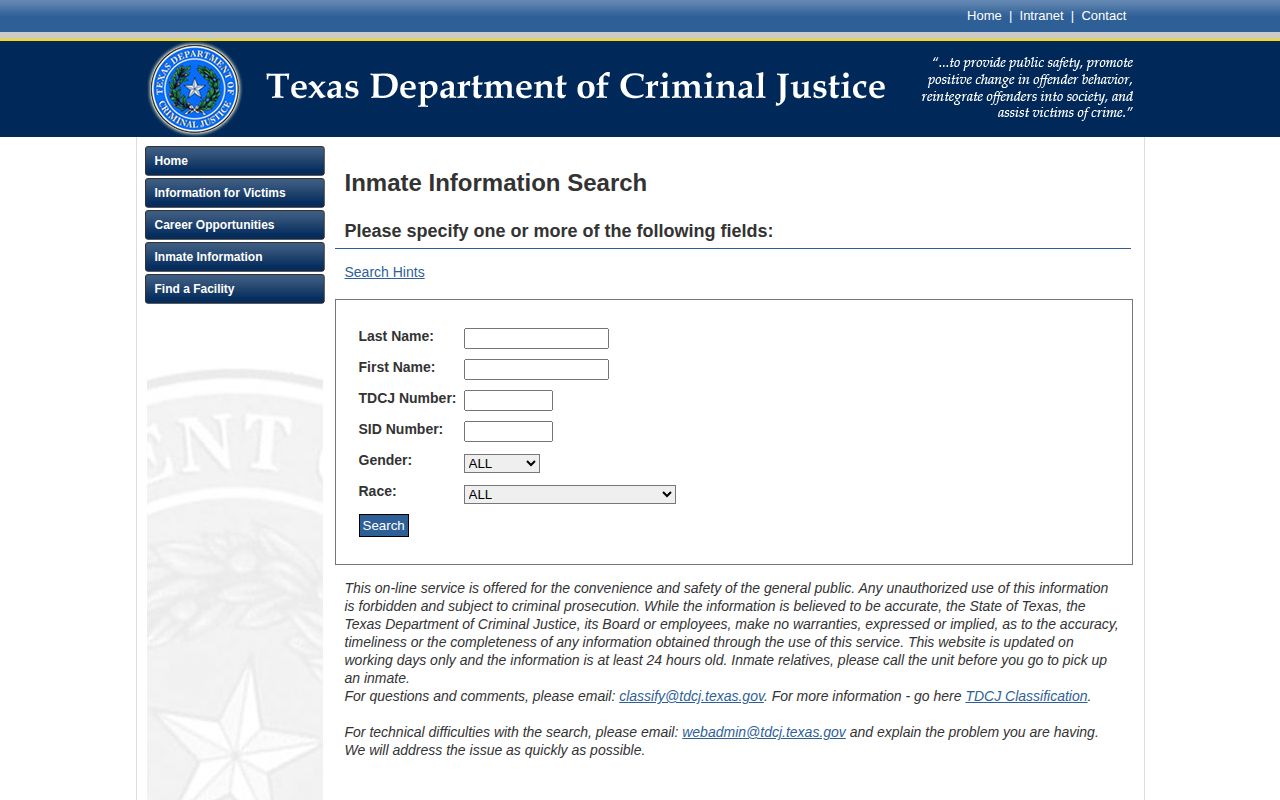
Disappearance from this search can be consistent with release, but it is not proof of release type or date.
Texas Good Time Calculations
Texas has no universal rule that everyone serves 85 percent. The phrase is often misapplied. For specified serious offenses, Government Code Section 508.145 can require actual calendar time equal to one-half of the sentence or a stated year cap before parole eligibility, subject to a minimum. That calculation is 50 percent, not 85 percent. Offense, offense date, sentence structure, findings, and prior record control.
Government Code Chapter 498 governs TDCJ good-conduct classifications and credits. It allows additional credit for qualifying work or programs in some cases, but good time is a privilege that can be forfeited. Credits affect only the calculations assigned by law. They do not erase every day from the maximum sentence or guarantee parole.
County time is separate. Code of Criminal Procedure Article 42.032 allows a sheriff to grant up to one day of commutation for each day actually served when its conditions are met. “May grant” is not automatic. ACSO publishes no local formula, so Jail Records or the sentencing court must supply the individual calculation.
Why Atascosa County Release Dates Change
A projected date can move when credits are earned, forfeited, or restored. A corrected judgment, added sentence, concurrent or consecutive term, jail-credit change, detainer, or late program completion may also alter the record. Parole action can create an earlier path, while release planning and a receiving hold can delay community departure.
| Change | Possible effect | Confirm with |
|---|---|---|
| Credit adjustment | Moves a statutory calculation | TDCJ or Jail Records |
| Corrected sentence | Changes term or credit | Sentencing court |
| Detainer | May cause transfer | Holding and receiving agencies |
| Board decision | Changes parole or mandatory-supervision path | Board and TDCJ |
| Required program | Can delay processing | TDCJ release processing |
The TDCJ definitions page gives the controlling explanation.
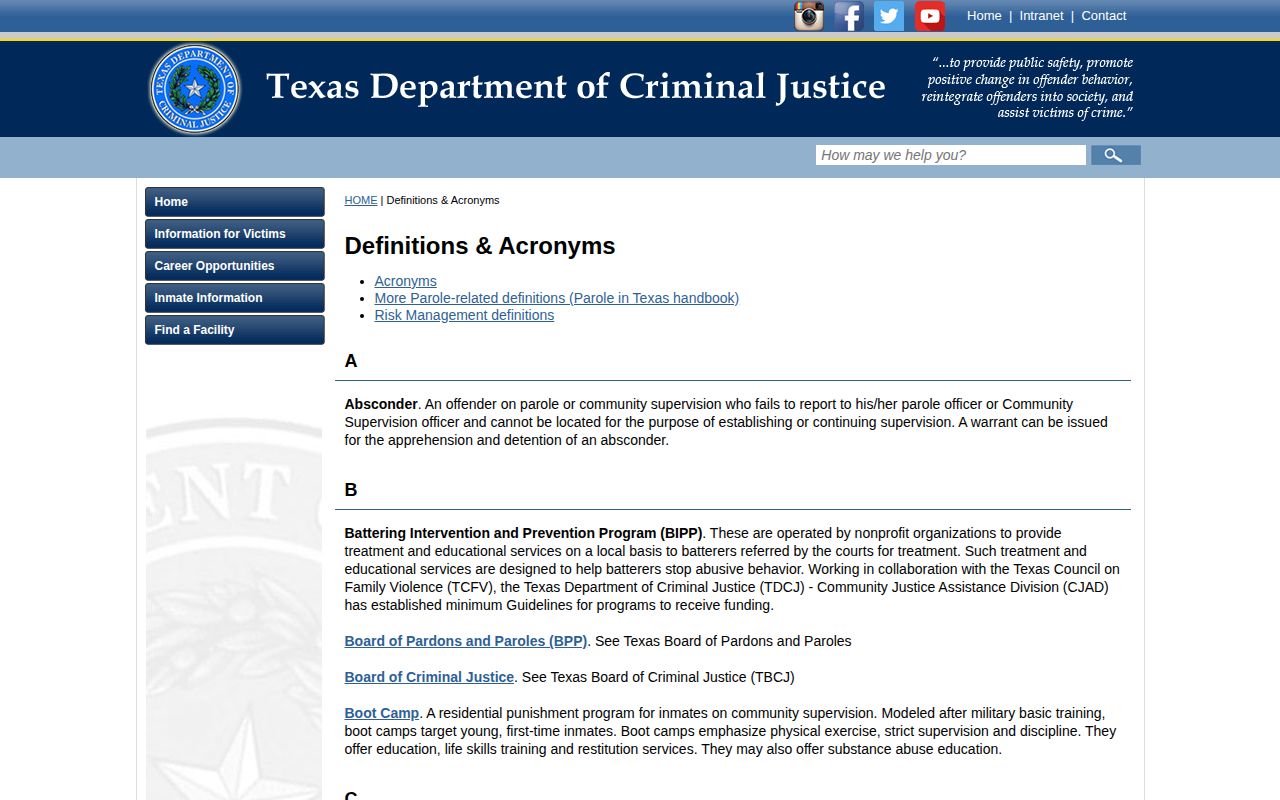
Use the value as a dated estimate and retain the source check date.
Confirm Atascosa County Actual Release
For an Atascosa jail departure, request the booking and release transaction from ACSO Jail Records at 830-769-3434 ext. 2239 or reports@acso-tx.org. Ask whether the event was bond, time served, court order, or transfer. A transfer to TDCJ, ICE, the U.S. Marshals, another county, or treatment custody is not freedom in the community.
For a Texas prison departure, use TDCJ release history, Classification and Records confirmation, a release certificate, Texas IVSS notification, and Parole Division when supervision follows. Compare the Atascosa judgment. A custody release can occur while the criminal case remains open, and parole can occur while the sentence remains active.
The Atascosa County released inmate search gives the broader county-record path. Preserve the exact status, event time, agency, and identifier.
When TDCJ Results Vanish
Texas creates an unusual negative-search problem. TDCJ limits its online tool to current prison inmates, so the result may disappear just when release confirmation matters most. No result can fit release, discharge, a data mismatch, or the fact that the person was never in TDCJ custody. It cannot identify which is true.
The post-release bridge is a TDCJ incarceration-history request, release or discharge record, state IVSS event, Parole Division confirmation, and the court file. TDCJ's history request page documents the route.
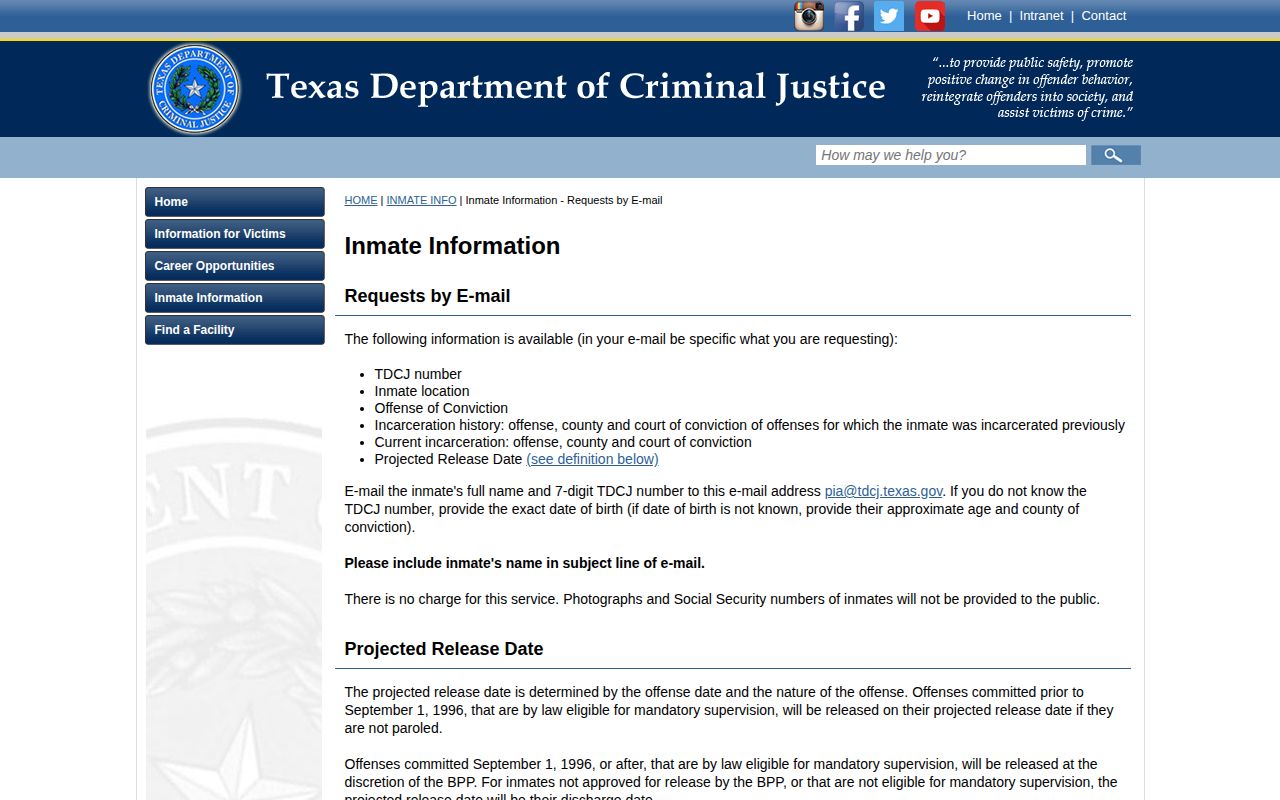
The historical record can preserve the custody trail after the live search stops returning the person.
Mandatory Supervision Date Changes
For an eligible offense committed on or after September 1, 1996, discretionary mandatory supervision requires Board approval. A denial can move the projected date to maximum expiration. If the Board later approves release, TDCJ may recalculate it earlier for processing. That large shift can be lawful and does not by itself show a clerical mistake.
Earlier eligible offenses follow another framework, while ineligible offenses may show projected release at maximum expiration unless parole occurs first. This offense-date split is why a generic percentage tool is unreliable. Ask TDCJ to explain the current field and calculation inputs for the named record.
A parole review outcome adds more terms to read. FI-1, FI-2, and program-conditioned FI results are approval paths, but they do not all direct release at once. RMS concerns mandatory supervision. Denial codes can set another review or require service under their stated rules. The vote date, target month, projected release field, and actual departure should be recorded as four separate facts.
The identity behind the date also needs care. Search with a TDCJ or SID number when possible, then compare name, age, offense county, sentence, and unit. People with similar names or more than one sentence can produce a wrong match. Record the day the result was checked because a projected field may later change for a lawful reason.
No public webpage can account for every input in an individual's calculation. Jail credit, disciplinary history, old-law provisions, Board action, and holds may sit with different custodians. A family estimate can be useful for planning, but only the responsible records office can state the agency's current date and explain which record controls it.
When requesting a review, supply the full name, TDCJ or SID number, sentence cause number, offense county, and the date shown online. Ask whether the displayed value is projected release, maximum expiration, parole eligibility, or a Board target month. Request the effective calculation date and identify any detainer or program condition that the office may lawfully confirm. Precise terms produce a more useful answer than asking for a single “out date.”
Board approval still does not set the moment someone walks out. TDCJ may need a verified release plan, a destination, program completion, and a review of holds from other agencies. A target month in an FI vote is not an actual release date. If another authority has lodged a detainer, the departure may be a custodial transfer. Record both the sending and receiving agencies before describing the event.
Atascosa court records can clarify sentence length, jail credit, concurrent or consecutive terms, and later corrections. They may not show the final physical release time. Conversely, a jail release transaction can show when custody changed without resolving the final case result. For a sound timeline, pair the signed judgment with the calculation and the eventual release or transfer record.