
Atascosa County Parole Versus Probation
Texas uses two distinct supervision tracks. Parole follows release from a TDCJ prison sentence after a decision by the Texas Board of Pardons and Paroles. The TDCJ Parole Division supervises the person in the community. Probation, formally called community supervision, is imposed by a court and is administered locally through a Community Supervision and Corrections Department, or CSCD. Atascosa County Adult Probation handles that court-based route. A person may therefore be free from jail yet still report to an officer under either system.
The sentencing judgment and the releasing agency usually identify the right track. A county jail release on bond is neither parole nor probation unless a court separately orders supervision. A transfer from Atascosa County Jail to TDCJ is also not a community release. The person remains in custody, and any later parole review belongs to the state system.
| Question | Parole | Probation |
|---|---|---|
| Who orders it? | Texas Board of Pardons and Paroles after a prison sentence | The sentencing court |
| Who supervises it? | TDCJ Parole Division | Atascosa County Adult Probation / CSCD |
| What proves status? | Board decision, release certificate, IVSS event, or Parole Division record | Judgment, community-supervision order, docket, or CSCD confirmation |
| How does it end? | Discharge, completion, or other Board/TDCJ action | Court termination, completion, revocation, or other signed order |
- Parole
- Conditional community release while a prison sentence remains active.
- Probation
- Court-ordered community supervision, often used instead of confinement or after a short jail term.
- Mandatory supervision
- A Texas release form governed by sentence credits, eligibility rules, and, for many later offenses, Board review.
- Discharge
- The formal end of the sentence or supervision term, not merely departure from a facility.
Verify Atascosa County Release Supervision
Start with the source that created the supervision. The Atascosa court file is primary for probation. TDCJ and the Board are primary for parole or mandatory supervision. The TDCJ online inmate search may show parole-review information while a person is still incarcerated, but it intentionally includes only people currently held in a TDCJ facility. Its failure to return a released person cannot prove discharge.
- Match the person with a case number, SID, TDCJ number, birth information, or another strong identifier. A name alone can join unrelated records.
- Read the Atascosa judgment or supervision order. District felony records run through the District Clerk, while county misdemeanor matters run through the County Clerk.
- For state parole, review the Board result while it remains available, check TDCJ IVSS, or call the Board status line at 844-512-0461.
- Contact the responsible office. Use Adult Probation for a court supervision question and the TDCJ Parole Division directory for post-prison supervision.
- Ask for the exact status and effective date. Active supervision, a pending review, an alleged violation, and final discharge are not interchangeable.
Keep a copy of the agency wording and the date checked. If sources conflict, ask each custodian which case, sentence, and identifier its record covers. The Atascosa County released inmate search supplies the broader custody and court path when the release type is still unclear.
Atascosa County Probation Records
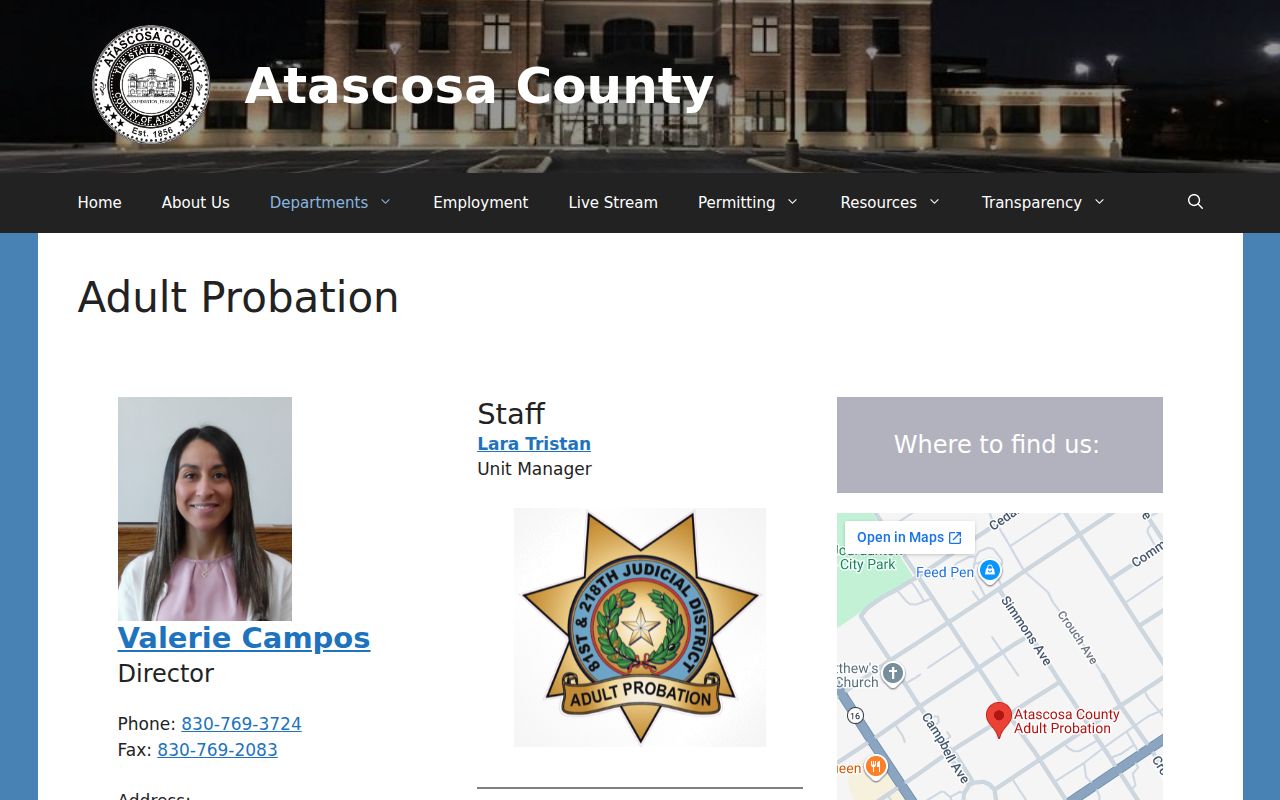
Atascosa County Adult Probation is the local contact for court community supervision. Its office can route a legitimate question within disclosure limits, but it is not a public list of everyone released from jail. TDCJ's Community Justice Assistance Division identifies the department as part of a five-county CSCD grouping that includes Atascosa, Frio, Karnes, La Salle, and Wilson counties.
1405 Campbell Avenue, Suite 102, North Entrance
Jourdanton, TX 78026
830-769-3724
Monday-Thursday 7:00 a.m.-5:00 p.m.
Friday 8:00 a.m.-5:00 p.m.
The official county page shows the local office and its extended weekday schedule. The source can be checked directly through the Adult Probation listing.
This contact is for probation and community supervision. State parole questions must still go to the Board or TDCJ Parole Division.
Atascosa County Parole Violations
Supervision conditions come from the court order, parole certificate, or supervising agency. They may address reporting, travel, programs, contact, or other case-specific duties. A missed appointment alone does not authorize a reader to declare that someone has absconded. An absconder is a person whom supervision authorities allege cannot be located or has failed to comply, and a warrant is a separate official action.
No Atascosa-specific public absconder list was found. Confirm an active warrant with the issuing court or agency. TDCJ IVSS may provide a warrant or supervision event when that event is covered, but an alert should be read literally and confirmed when immediate action depends on it. Revocation also has its own process. It does not erase the fact that the original release occurred.
Atascosa County Supervision Discharge
Probation normally ends through completion or a signed court order, though a court can also modify, extend, or revoke it under governing law. The durable proof is the Atascosa case record and termination order. For parole, use a TDCJ or Board record showing discharge or another final status. Leaving prison is not itself a discharge because the person may still serve the sentence under supervision.
After a TDCJ discharge, the current-inmate search may no longer show the person. Request prior incarceration and release history through TDCJ offender information, and preserve any release certificate or IVSS notice. Texas public-record access is governed by Government Code Chapter 552, subject to applicable exceptions. Ask for the named record and date rather than treating an empty live search as proof.
Texas Parole File Votes
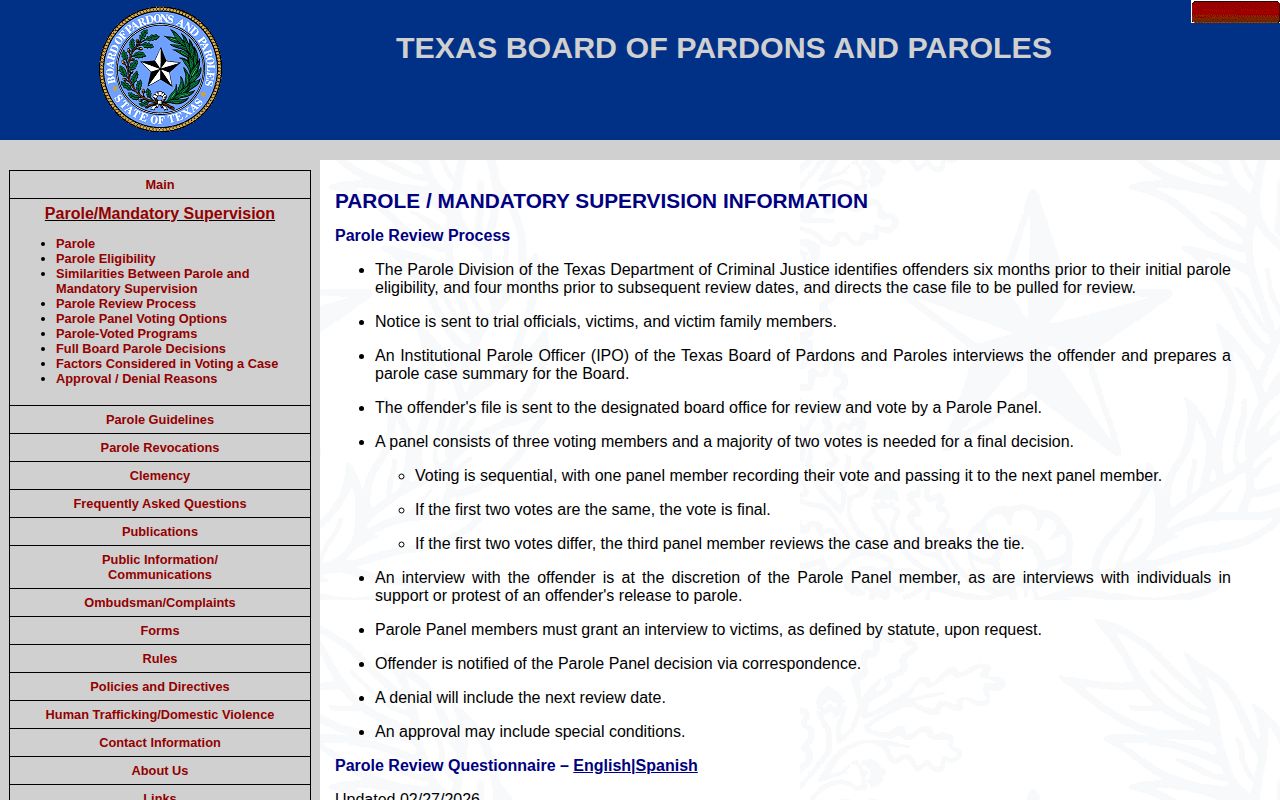
Texas does not conduct a formal public hearing for ordinary parole or mandatory-release consideration. The Board's parole review FAQ explains that panel members vote the file individually. An institutional parole officer prepares a case summary, and a three-member panel votes in sequence. Two concurring votes decide the result. Board meetings and workshops are different and are not a named person's parole calendar.
Initial review identification generally starts about six months before eligibility, while later reviews begin about four months before the review date. Codes carry distinct meanings. FI-1 directs release when eligible; FI-2 names a later month and year; program-conditioned FI votes require completion of a named program. RMS approves mandatory supervision. NR, SA, and DMS are denial outcomes with different next steps. No code is the same as an actual gate date because detainer checks, release plans, required programs, and processing may remain.
The official Texas parole review timeline illustrates this file-vote process.
Read a result with the eligibility date, vote date, target month, and eventual release transaction kept separate.
Which Atascosa County Supervision Office?
The local Jourdanton Adult Probation office is the distinctive Atascosa route for court community supervision. Its five-county CSCD grouping does not turn it into a state parole office. TDCJ Parole Division is responsible for people released from a Texas prison on parole or mandatory supervision, while the Board makes the release decision. Calling the wrong office can yield a truthful “no record” that says nothing about the other system.
Before calling, note the sentencing court, custody source, release type, and identifying number. Ask Adult Probation about a court order or termination. Ask the Board about a parole decision and Parole Division about active post-prison supervision. This agency split is more reliable than searching for one broad Atascosa County parole and probation roster, which official sources do not provide.
A court docket can resolve several local probation questions. The signed judgment identifies whether community supervision was ordered, while later entries may include a modification, motion to revoke, capias, or termination order. District felony matters belong with the Atascosa District Clerk. County misdemeanor matters belong with the County Clerk and County Court at Law. A missing result in one clerk's portal should not be treated as a negative result in the other court system.
For parole, preserve the release certificate and Board result when lawfully available. The current TDCJ inmate result may disappear after physical release because the online tool is limited to current inmates. State IVSS, the Board status line, TDCJ release history, and Parole Division then become the durable bridge. These sources can distinguish active parole from mandatory supervision and final discharge.