
Understanding Atascosa County Releases
A release record answers a narrow but vital question: when and under what authority did Atascosa County Jail give up physical custody? It does not, by itself, say that a charge ended or that the person went home. The jail may release someone on bond, after time served, or under a court order. It may also transfer someone to the Texas Department of Criminal Justice, another county, a treatment site, a hospital, ICE, or the U.S. Marshals Service. Only the first group clearly describes a community departure.
Booking, custody, and court records serve different roles. The booking record explains how the custody episode began. The release transaction records its end at the county jail. A court judgment or order explains the legal case. Matching all three prevents a missing name from being treated as proof of freedom, dismissal, or innocence. Atascosa County has no official public current roster or historical release feed in the researched county channels, so the documentary path through ACSO Jail Records is central.
- Discharge
- The end of a custody or sentence status shown by the responsible agency.
- Time served
- A release based on credited confinement or a completed local sentence.
- Transfer
- A change of custodian, not release to the public.
- Parole
- Conditional release from TDCJ while the state sentence continues.
- Probation
- Court-ordered community supervision administered locally rather than by the state parole system.
Atascosa County Release Types
ACSO does not publish a local release-code legend. The exact code must therefore come from the release sheet, not an assumption based on timing. Bond permits conditional liberty while a case continues. A dismissal concerns the prosecution, while a release sheet may merely cite the order that ended custody. Probation can follow a court sentence without ever becoming parole. Mandatory supervision is a Texas statutory release process, but eligibility and Board review rules mean the word “mandatory” does not promise automatic release.
| Recorded event | Meaning | Next place to verify |
|---|---|---|
| Surety, cash, or personal bond | Conditional release while the case may remain open | Release sheet and court docket |
| Time served or sentence satisfied | Authorized end of that confinement calculation | Release sheet and judgment |
| Probation order | Local court supervision outside jail | Sentencing court and Adult Probation |
| Parole or mandatory supervision | State prison release with a sentence still active | TDCJ records, Board, Parole Division, and IVSS |
| Transfer or detainer pickup | Another agency took custody | Receiving agency record |
A release from ACSO custody can coexist with custody elsewhere. Ask for the receiving agency and transfer destination when those fields are public. A signed court disposition is also essential when the goal is to determine whether the case was dismissed, resolved by plea or judgment, or remains open.
Atascosa County Release Record Fields
No official ACSO online field list was found. A focused request should identify the custody episode and ask for existing booking and release records. Useful identifiers include full name and aliases, date of birth when known, booking number, arresting agency, and approximate booking date. Request fields without claiming that every one exists or is releasable.
| Requested field | What it can establish |
|---|---|
| Booking number and intake date | Links the release to the correct custody episode |
| Release date and time | Records when ACSO relinquished custody |
| Release type or authority | Identifies bond, court order, sentence completion, or another basis |
| Releasing agency or staff transaction | Shows which office processed the event |
| Receiving agency or destination | Helps separate transfer from community release |
| Booking sheet and photograph | Ties the release back to the original booking record |
The county jail register has a permanent minimum under Texas Local Schedule PS. Detailed prisoner files covering booking in and out, transfer, release, commitment, transport, and authorizing court records generally have a minimum of release or transfer plus two years. That schedule governs retention, not online display or automatic disclosure. An agency can retain a record longer, redact protected fields, or apply a legal hold.
Request Atascosa County Release Records
The Atascosa County Sheriff's Office lists reports@acso-tx.org for Texas Public Information Act requests. Booking and Inmate Information is extension 2231, Jail Records is extension 2239, and Open Records is extension 2243 through 830-769-3434. ACSO publishes no release-record or booking-photo fee schedule, so request electronic copies and ask for an estimate before charges are incurred.
- Identify the person with a full name, known alias, date of birth, booking number, and approximate custody dates.
- Ask for the booking sheet, release sheet or custody-release transaction, recorded date and time, release authority, and receiving agency if the event was a transfer.
- State that electronic copies are preferred. Ask for written itemization before charges above a chosen limit.
- Compare the response with the correct court case and any receiving-agency record. Preserve the exact release code rather than rewriting its meaning.
1108 Campbell Avenue
Jourdanton, TX 78026
830-769-3434
Open Records ext. 2243
reports@acso-tx.org
The Texas Public Information Act calls for prompt production. A ten-business-day rule applies when a governmental body seeks an Attorney General ruling, but it is not a promise that every request finishes in ten days. If anticipated charges exceed $40, state guidance generally calls for an itemized estimate. Ask for existing records rather than requiring ACSO to create a new report.
Atascosa Release Records and Expunction
Government Code Chapter 552 starts with public-information procedures but contains exceptions for law-enforcement material, confidential criminal history, birth dates, medical facts, victims, security information, and other protected data. Juvenile files follow separate law and are not part of an adult Atascosa County released inmate search. A custodian, not a search user, decides what must be redacted or withheld.
Texas expunction law appears in Code of Criminal Procedure Chapter 55A. Eligibility turns on the exact case history and statutory conditions, not release alone. Nondisclosure under Government Code Chapter 411 restricts access in a different way and does not mean every record is destroyed. The Atascosa District Clerk publishes a local service list naming ACSO, clerks, prosecutors, DPS, municipal offices and courts, and justices of the peace. That list helps route a signed order; it does not decide eligibility or bind every private copy.
When Atascosa Jail Releases Process
ACSO publishes two inmate-release processing times, 8:00 a.m. and 10:00 p.m. daily. “Daily” supports weekend processing, but those times are not a list of people released in the prior day. They also are not a promise that a named person will walk out at either time. Identity review, active detainers, property and account work, court authority, and transport coordination can affect actual completion.
The county page does not identify a release door, holiday exception, queue rule, or family waiting area. Call Booking before traveling and ask Jail Records for the actual transaction afterward. A custody notice may arrive at a different minute from physical departure because data transmission and release processing are separate events.
Atascosa Bond Fee and Release
The sheriff lists a $15 State Bond Fee for each surety bond, capped at $30, payable by exact cash or money order. This is an administrative fee. It is not the bond amount set by a judge, a full fee schedule, or proof that release has completed. A payment receipt should be matched to the booking number, bond authority, and later release transaction.
Bond also does not close the criminal case. Check the proper clerk portal for later settings and orders. A future court date can remain even after Atascosa County Jail records a community release on bond.
Getting Home After Atascosa Release
Cowboy Connect publishes hourly time-point loops between Jourdanton and Poteet and Pleasanton. Alamo Regional Transit permits a route deviation of up to one-half mile for an extra cost when arranged through 1-866-889-7433 or needaride@aacog.com during published weekday hours. The jail is not named as a stop. Treat the route as a nearby planning lead, not jail-door pickup.
Because ACSO also does not publish an exit door or waiting area, confirm a safe meeting place directly with the jail. A late processing time can fall outside transit office hours. Release authorization and transport availability are separate issues.
Find Released Atascosa County Inmates
No official ACSO recent-release list was found. A dependable search starts with the custody episode, then follows the record to its next custodian or court. Use a date of birth, middle name, booking number, TDCJ or federal number, case number, and approximate dates to distinguish namesakes.
- Call ACSO Booking at extension 2231 to ask whether the person is presently booked. If not, request the historical release or transfer transaction from Jail Records.
- Read the release type and receiving agency. Do not turn “no longer here” into a claim of community release.
- Check the District Clerk for felony or district matters and the County Clerk for county misdemeanor matters. Match case number and dates.
- If the record shows TDCJ, federal, or immigration transfer, use that system's locator or records channel. For supervision, use Adult Probation or TDCJ Parole Division as appropriate.
- Use IVSS as a notification and corroboration channel. Confirm urgent facts with the agency that sent the event.
The 24-Hour Release List page explains the named-person fallback for a one-day window. A state inmate's Projected Release Date is an estimate before release, not a historical county release entry.
TDCJ Search for Atascosa Releases
The TDCJ Online Inmate Search explicitly includes only people currently incarcerated in a TDCJ facility. It can show a current state prisoner's unit, projected release date, maximum sentence date, parole review information, and offense county. It is not an online archive of discharged people. Someone transferred from Atascosa County Jail may also take time to appear after TDCJ intake.
| Search field | Best use |
|---|---|
| TDCJ number | Strong match to a state custody record |
| SID number | Distinguishes people with similar names |
| First and last name | Broad search when an agency number is unknown |
| Age, race, and sex | Narrows and checks a possible match |
| Offense county | Can connect a state record to Atascosa County |
The official TDCJ information request page is the bridge after discharge. Request incarceration history plus the date and type of release or discharge, using a TDCJ or SID number when possible. Then determine whether parole or mandatory supervision began, or whether the sentence fully discharged.
The official search screen shows its current-custody limitation. 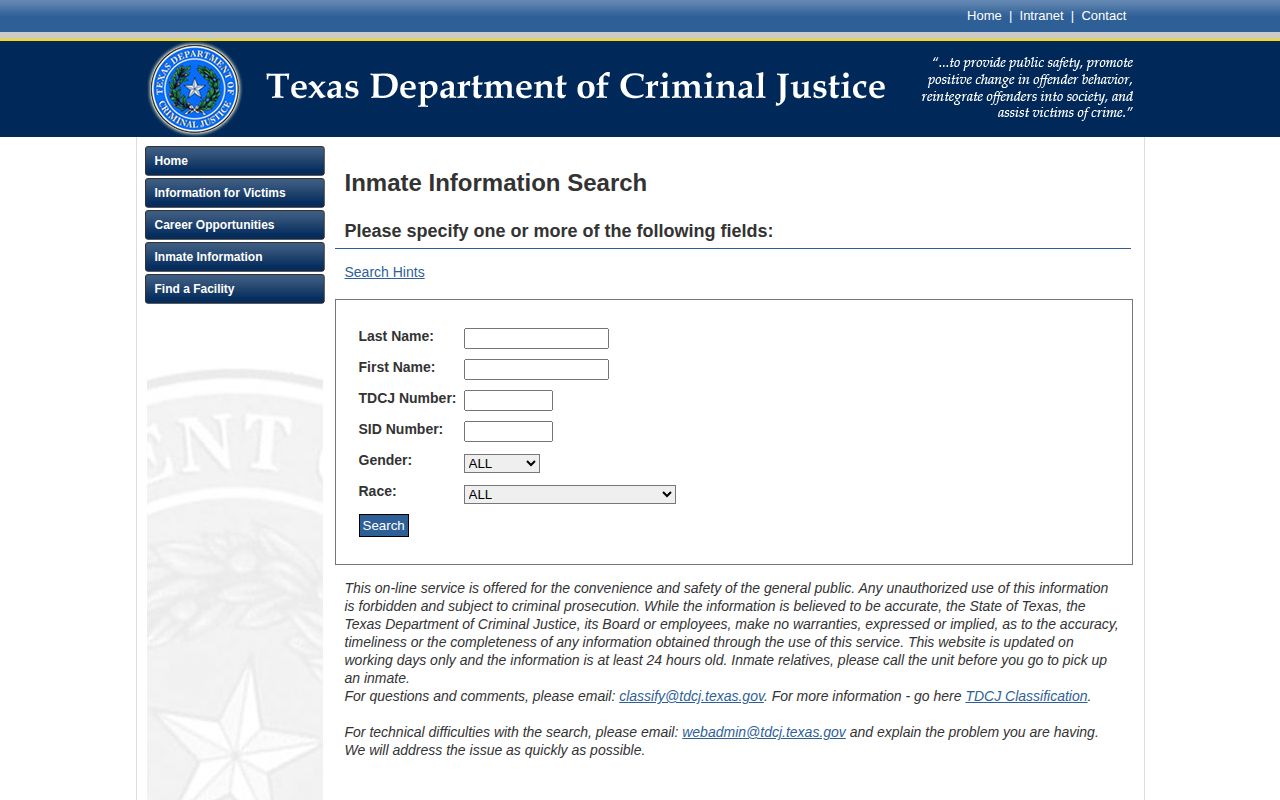 That warning explains why a missing post-release result must lead to TDCJ history, IVSS, and Parole Division rather than a conclusion based on silence.
Atascosa Release Court Record Split
Atascosa County has two durable court paths. The District Clerk handles district and felony records through its linked portal, where guest access provides index information and previews and searching is free, though images may require purchase or registration. The County Clerk is the route for county misdemeanor matters. A no-result in one portal does not clear the other court system.
Look for a bond order, judgment, sentence, dismissal, supervision order, warrant event, mandate, or expunction order. The court record can prove legal disposition but may omit the jail's precise physical release time. The jail transaction provides that custody fact but may not explain the final case outcome. Use both records.
Verify Atascosa Post-Release Supervision
Atascosa County Adult Probation administers local court-ordered community supervision. TDCJ Parole Division supervises eligible people released from state prison on parole or mandatory supervision, while the Texas Board of Pardons and Paroles makes release decisions. These offices cannot substitute for one another.
For probation, use the sentencing order and contact the local office at 1405 Campbell Avenue, Suite 102, Jourdanton, 830-769-3724. For parole, consult TDCJ review information before release, then IVSS, the Board status line, and the responsible Parole Division office. An approval code is not the gate date. Program work, detainer review, and release planning can remain. The full Parole & Probation page separates these Texas processes.
Atascosa Release Alerts and Transfers
ACSO links the Texas IVSS-Counties portal for county offender search and notifications. Texas moved county notification from VINE to IVSS-Counties in 2025, so “VINELink” is legacy search language locally. The state TDCJ IVSS portal covers state prison, parole, mandatory-supervision, release, discharge, and warrant events as applicable. Keep county and state registrations distinct.
Federal custody has separate proof. The BOP locator can retain a federal “Released” result and date, but says nothing conclusive about county, state, ICE, or supervision status. The ICE detainee locator covers current detainees and people released from ICE custody within a limited recent window. An ACSO handoff to ICE or USMS is a transfer, not unrestricted release.
Atascosa Custody and Release Sources
Choose the record by the question it can answer. No single system proves every stage.
| Source | What it covers | Main limit |
|---|---|---|
| ACSO Booking | Present county-jail status | A no answer does not explain departure |
| ACSO release transaction | Date, authority, and possible receiving agency | May not show final court result |
| District or County Clerk | Case orders, judgment, sentence, dismissal | May not show gate time |
| TDCJ online search | Current state incarceration and projected dates | Excludes discharged people |
| IVSS | Reported custody and supervision events | Coverage and transmission can vary |
| BOP or ICE locator | That federal system's custody | Does not rule out another custodian |
How Atascosa Jail Changed
An official TDLR project record documents a planned 2018–2019 addition at 1108 Campbell Avenue. It describes 116 new housing beds, a training room, renovations, and remodeling in a project estimated near $10 million. This is facility history, not a current inmate count or release statistic.
The project helps identify the physical jail site but cannot answer whether a named person left custody. That still requires the ACSO release transaction and, when relevant, the receiving agency's record.
Atascosa County Release Systems
Atascosa County Jail is the only adult local detention facility found. The Juvenile Detention Center is a separate confidential youth system and must not be searched through adult tools. No TDCJ unit is located in the county, but the TDCJ correctional system receives qualifying transfers and controls state releases. The BOP release system and ICE and USMS custody paths apply only when federal authority is involved.
Start with the agency that last held the person. Follow the release or transfer field to the next source, then corroborate it with the court or supervision record. That chain gives an Atascosa County released inmate search a firm event and date rather than a guess based on an absent name.